Contact Us

Use the form on the right to contact us.

You can edit the text in this area, and change where the contact form on the right submits to, by entering edit mode using the modes on the bottom right. 


Martinsburg
United States

benjaminspring2015 (4 of 15).jpg

Alcove

Our Daily Work

alec vanderboom

Just another ordinary, busy day as a mother. Filled to the brim with tasks for many small people, plus a few larger ones as well. Nothing unusual. Yet, take a look at how beautiful the simple task of answering a "can I go out and play" question while changing the bedsheets can look through the perspective of time.

Pieter de Hooch
The Bedroom, 1658/1660
Widener Collection
National Gallery, Washington D.C.

"[This painting] depicts a mother changing the linen in a “sleeping cupboard” while her daughter seems to ask to go out in the backyard to play. The tidy parlor, lined in blue-and-white glazed tiles, recalls that Delft was a major ceramic center. It is noteworthy that even this modest household proudly displays three framed paintings and mirrors." (NGA Website)

Prayer: Lord, infuse us with the spirit of Mary while we complete our many Martha tasks.

Good Shepard

alec vanderboom


Good Shepherd, Roman Catacomb

Psalm 23
The Lord is my shepherd.
I shall not want
In verdant pastures
He gives me repose.

He guides me in right paths
For his namesake.
Even thought I walk in the dark valley,
I fear no evil;
For you are at my side
With your rod and your staff
That give me courage.

You spread the table before me
In the sight of my foes
That give me courage.

You spread the table before me
In the sight of my foes
You anoint my head with oil
My cup overflows.

Only goodness and kindness follow me
All the days of my life
And I shall dwell in the house of the Lord
For years to come.

Friday's Passion

alec vanderboom

It’s been a rough week at the Benjamin household. Each kid has a unique challenge this week: stomach flu, failed potty training and teething. In the midst of this, I accidentally forced myself to attend traffic court this morning. (Who can remember to timely pay their dead tag tickets in the midst of all of this family chaos?) The three hour round trip into the city was just what I needed to reflect on how truly blessed I am.

While I was appreciating the lovely solitude of my journey, I ran into an extremely harried female lawyer on the steps of the courthouse. She was anxiously waiting for her client to appear. I’ve shared that look so many times in the past, I recognized her feelings immediately. I just said a prayer of Thanksgiving because I’m so thankful that I’m not “working” anymore. My work is helping this little family hang together in the rough times. When my kids get sick, it just means more sleeplessness and more piles of laundry for me. I don’t have to scramble for sick kid care or problem-solve on the cell-phone from a business meeting.

This stay-at-home life is a rare gift in modern life. Having a Catholic faith and strong marriage is an even greater blessing.

Here to celebrate the beloved gift of marriage is a portrait of Marc Chagall’s beloved wife, Isabella. I love how this sinewy mother floats gracefully over the laundry and a laughing husband and child. I’ll have to strive for more graceful “floating” this weekend.

Bella with a White Collar, 1917

Since it is a Lenten Friday today, check out Chagall's haunting crucifixion scene.

White Crucifixion

This painting emphasizes Jesus' Jewish faith. He has a prayer shawl wrapped around him. Surrounding him are scenes from Stalin's progams against the Soviet Jews. You can see the crowd bearing Red Soviet flags in upper left hand corner, along with burnt houses and a rabbi consoling his crying congregation. A robber in green makes off with stolen treasure. In the lower right hand corner, a precious torah is being burned. (Chagall was a Russian Jew and endured many trials before finally coming to the US.)

Prayer: Father, may we never take the sacrifice of your Son for granted. May we believe in his power to ransom us from sin. May we share his peace always with our Jewish elder brothers in the faith.

St. John of the Cross

alec vanderboom


Francisco Antonio Gijón, St John of The Cross, 17th Century

"Painted in lifelike tones and gilded with extensive decoration, the statue corresponds closely to a work described in a document found in the Seville archives of a now-disbanded Carmelite convent, Nuestra Señora de los Remedios. According to the document, the Spanish convent commissioned the sculptor Francisco Antonio Gijón (1653-c. 1720) to make a life-size painted-wood statue of Saint John of the Cross on the occasion of his beatification in 1675. Though little-known today, Gijón was one of the leading sculptors of the Spanish Baroque working in Seville.

The statue, which is five feet five inches tall, is a superb example of the technique of estofado decoration, where one layer of paint is scratched to reveal another of contrasting color. The robes of Saint John of the Cross feature colored paint laid over gold leaf, then scratched away to show the gilding underneath, creating rich patterns. The saint stands with outstretched hands, holding in his left an open book from which a small mountain rises. The mountain is both a symbol of the Carmelite order, which traces its origins to twelfth-century Christians who lived in caves on Mount Carmel in the Holy Land, and a reference to Saint John's poem, The Ascent of Mount Carmel, the book the saint holds. The right hand of the statue once held a feather-quill pen, now missing; also missing is a cross on top of the mountain.

Saint John of the Cross

Called by Thomas Merton "one of the greatest and most hidden of the saints," Saint John of the Cross (1542-1591) was a cofounder, with Saint Teresa of Avila, of the "discalced," or shoeless, a branch of the order of The Carmelites of the Roman Catholic Church. In this reform movement, which advocated a more severe form of monasticism, the monks wore the sandals of the poor rather than the shoes of the upper classes; some of the more radical friars went barefoot to indicate their commitment to poverty.

Because of his ardor in pursuing these reforms, John was imprisoned in Toledo in 1576. In his prison cell he began his famous Spiritual Canticle and Songs of the Soul. After an escape in 1578 considered by many to be miraculous, he went to Andalusia, where he wrote the remarkable mystical poems, The Ascent of Mount Carmel, and The Dark Night of the Soul. John of the Cross was beatified in 1675 and canonized in 1726. He is today considered one of Spain's finest lyric poets." (NGA Website).

St. John of the Cross, pray for us. Kindle our hearts anew with the flame of devotion to Christ.

Chalice

alec vanderboom


National Gallary, Washington, D.C.

"This chalice, a vessel to hold wine for Mass, is one of the most splendid treasures from the Middle Ages. Acquired by Abbot Suger for the French royal abbey of Saint-Denis, near Paris, the stone cup was set in gold and probably used in the consecration ceremony for the new altar chapels of the church on 11 June 1144.

Suger, abbot of Saint-Denis from 1122 to 1151, was not only a Benedictine monk but also a brilliant administrator who served as regent of France during the Second Crusade. With objects such as this chalice and the abbey's new Gothic architecture, he aimed to create a vision of paradise on earth that would awe beholders. In his writings, Suger equated Divine Light with the real light shimmering through stained glass and glistening from gems.

The cup incorporated in Abbot Suger's chalice was carved from sardonyx, probably in Alexandria, Egypt during the second to first centuries B.C. Suger's goldsmiths mounted the cup in a gold and silver setting with delicate gold-wire filigree and adorned it with gems. On the foot, a medallion depicts the haloed Christ, flanked by the Greek letters signifying: "I am the Alpha and Omega, the Beginning and the End." (NGA website)

Father: Circumcise our hearts anew this Lent. On Easter Sunday, may we all drink your son's Blood with humble, grateful hearts.

How will I know this is so? How can this be?

alec vanderboom


Michelangelo, Zechariah, Sistine Chapel
Luke 1. 18-20
"Zechariah said to the angel, "How will I know that this is so? For I am an old man, and my wife is getting on in years. The angel replied, I am Gabriel. I stand in the presence of God, and I have been sent to you and to bring you this good news. But now, because you did not believe my words, which will be fulfilled in their time, you will become mute, unable to speak, until the day that these things occur."


Giovanni di Paolo
The Annunciation and Expulsion from Paradise, c. 1435
National Gallery, Washington D.C.
Luke 1.
"Mary said to the angel, 'How can this be, since I am a virgin?' The angel said to her, "The Holy Spirit will come upon you, and the power of the Most High will overshadow you; therefore the child to be born will be holy; he will be called Son of God. And now, your relative Elizabeth in her old age has also conceived a son; and this is the sixth month for her who was said to be barren. For nothing will be impossible with God."

During confession today, my spiritual advisor gave me two beautiful images to contemplate; Our Blessed Mother and Zechariah. Six years into the Catholic faith and I still grapple with the issue of Transubstantiation. I had confessed this as having “doubts.” My confessor gently pointed out that we need to separate “doubt”, which is sinful behavior, from honest “questioning” which is encouraged as a necessary part of our spiritual growth.

Our approach should always be “Lord, I believe! Help my unbelief”. We know the Lord is present in the Eucharist, yet we can struggle with the part of ourselves that says “how can this be.”

To illustrate the difference between doubt and sincere questions, the Holy Scripture gives us Zechariah and Our Blessed Mother. The angel Gabriel comes to both devout people the blessed news of a future pregnancy. Zechariah’s response is “How will I know this to be so?” Zechariah sees the angel Gabriel in all his glory, yet he doubts the truth of this message. Zechariah’s response is to argue against the feasibility of new life since “the facts” of biology seem to make it impossible. Gabriel answers “nothing is impossible for God” and strikes Zechariah mute.

Meanwhile, Mary is also “much perplexed” by Gabriel’s announcement that she is to bear the Messiah. She doesn’t doubt that Gabriel’s announcement is true. Yet she still struggles to comprehend it. Her questions “How can this be, since I am a virgin?” Because her question is drenched in humility, Gabriel answers it. She receives an explanation of the workings of the Holy Spirit and confirmation of her relative Elizabeth’s miraculous pregnancy.

The teachings of our faith, which they see so easy to explain to my four year old, can be challenging for adults. The answers will come based on our own receptivity. Will we ask our questions with the humility of Our Blessed Mother, or the arrogance of Zechariah?

Prayer: Blessed Mother, instruct all of your dear children in the truth of the faith. Pray that their ears are open and receptive to the truth.

In Praise of St. Peter's Chair

alec vanderboom


Berini's gilt bronz casting of the relic of Chair of St. Peter, 1647-53, Rome
Genesis 22.1-19

“After these things God tested Abraham. He said to him, ‘Abraham!’ And he said “Here I am.” He said, “Take your son, your only son Isaac, whom you love, and go to the land of Moriah, and offer him there as a burnt-offering on one of the mountains that I shall show you.” So Abraham rose early in the morning, saddled his donkey, and took two of his young men with him, and his son Isaac; he cut the wood for the burnt offering, and set out and went to the place in the distance that God had shown him. On the third day Abraham looked up and saw the place far away. Then Abraham said to his young men, “Stay here with the donkey; the boy and I will go over there; we will worship, and then we will come back to you.” Abraham took the wood of the burnt-offering and laid it on his son Isaac, and he himself carried the fire and the knife. So the two of them walked on together. Isaac said to his father Abraham, “Father!” And he said, “Here I am, my son.” He said, “The fire and the wood are here, but where is the lamb for a burnt-offering?” Abraham said, “God himself with provide the lamb for a burnt-offering, my son.” So the two of them walked on together.

When they came to the place that God had shown him, Abraham built an altar there and laid the wood in order. He bound his son Isaac, and laid him on the altar, on top of the wood. Then Abraham reached out his hand and took the knife to kill his son. But the angel of the Lord called to him from heaven, and said, “Abraham, Abraham!” And he said, “Here I am.” He said, “Do not lay your hand on the boy or do anything to him; for now I know that you fear God, since you have not withheld your son, your only son, from me.” And Abraham looked up and saw a ram, caught in a thicket by its horns. Abraham went and took the ram and offered it up as a burnt-offering instead of his son. So Abraham called that place, The Lord will provide,” as its said to this day, “on the mount of the Lord it shall be provided.”

The angel of the Lord called to Abraham a second time from heaven, and said, “By myself I have sworn, says the Lord: because you have done this, and have not withheld your son, your only son, I will indeed bless you, and I will make you offspring as numerous as the stars of heaven and as the sand that is on the seashore. And your offspring shall possess the gates of their enemies, and by your offspring shall all the nations of the earth gain blessing for themselves, because you have obeyed my voice.” So Abraham returned to his young men, and they arose and went to together to Beer-sheba; and Abraham lived at Beer-sheba.”

Two years ago, I freaked out the leader of my Mother’s Rosary Group with a series of intense questions about this readings. I had grown up hearing this Bible story in Sunday School, of course. Yet one Easter Vigil, the intensity of this reading hit my soul.

We, the descendants of Abraham, received our blessings because our ancestor was a man ready to kill his son at the command of God.

How did Abraham know for certain that Isaac's sacrifice was demanded by God? What did he think about during his three-day trek to the mountain with Isaac? Did he tell Sarah what he was going to do to Isaac? Did she get to say goodbye to her son? If he kept it a secret from her, what did that say about their marriage?

After the Angel stopped Abraham, what happened next? Even if Abraham was stopped at the last moment, Isaac now knows that his father is willing to kill him? How could Isaac forgive his father? Would that event mar the father/son relationship forever? How could Sarah forgive Abraham when he got back home and told her what happened?

It felt downright creepy to celebrate an act of inter-family violence that was commanded by God, and then stayed by God at the last moment.

I don’t have answers to those questions. Somehow, they don’t bother me as much. The reading now makes sense on an emotional level, if not clearly on an intellectual level: that God would send his blessings down on the one human family that clearly demonstrated the trait of “obedience.”

Today’s Washington Post contains a scathing attack on the authority of the U.S. Counsel of Bishops. I realize that obedience is something we Catholic still struggle to uphold. If we think of our Bishop, and ultimately our Holy Father, as just two more authority figures in our lives, it is easy to feel rebellious. It’s much, much more difficult to view the hierarchy of the Roman Catholic Church as clearly linked to the authority of the Holy Spirit. I hope Bernini's St. Peter’s Chair makes that linkage a little more obvious for us.

Prayer: Father Abraham, pray for us. Help us to trust the voice of the shepard and safely remain within the folds of the church.

Falling Slowly - A Scene From Once

alec vanderboom

THE most beautiful song from tonight's Oscars ceremony! (Well, aside from the brilliant Edif Pilaf.) Here is the song in it's movie context. If you haven't checked out "Once", its an amazing trip through the life of musicians. Not the famous head liners in rock concerts. But the ordinary stars of our everyday world, the ones who compose tunes after their day jobs fixing vacuum cleaners. There is even a "chastity" ending which went straight to my heart.

Prayer: Father, bless our artists. Help us compose songs, write scripts, and make movies which reflect your truth and glory.

Mary Magdalene

alec vanderboom


Penance of Mary Magdalene, El Greco,1450

I joined the Catholic Church, and hence got introduced to the power of the Communion of the Saints, at the same time as the book "Da Vinci" Code was initially published. I stayed away from thinking much about Mary Magdalene. She seemed a little dangerous and highly charged. I didn't think for a second that she founded a secret family in France. Yet who was she really? A reformed prostitute or just a very sick rich woman "who had seven demons." It just seemed safer to stay away and hang out with more socially approved saints, such as Saint Francis of Assisi.

This Lent, I realized that I've been selling myself short but skipping out on devotion to the woman who first witnessed Christ's resurrection. I've prayed to her a lot for help with the instant conversion of sin that she experienced and for her faith in the resurrection.

This painting by the great El Greco shows her in this light, a sincere contrite heart who is about to experience the great blessing of faith.

Prayer: Mary Magdalene, pray for us. May we share in your penance this Lent. May we experience the fullness of your joy and faith this Easter Morning!

They Make Frogs Smoke

alec vanderboom

While we are on the abstract art kick, I'm taking a chance and adding an interesting "art" video. This song is about little boys. Boys have the potential to use all that wonderful innate physicality to become aggressive unless they are filled with "good things."

Here are the song lyrics which perfectly describe my nature walks with Alex some days.
"Oh, don't pull its legs. (They're pulled).
Don't squeeze it too hard,
Don't mash it up!

If you snap it like a twig,
Glue it back with little sticks,
Put it back into the grass again."

(I hope to guide Alex into a more respectful, more gentle observer of nature before he grows into the cub scout age!)

The video starts with butterflies, trees and a beautiful lake scene. The "cub scout" boys are obvious to the innate peace of this nature experience. The boys are filled with bitterness and angry thoughts. In their self-portraits, red spots literally drip from their eyes and their mouth. (I love how the individual drawings are crumpled up after each take). The video gets a little gory in the middle as the boys start drawing pictures of hurting their pets & their desire to start forest fires. (I'm so sorry You Tube choose the kitten scene as the still shot for this video!) In the end, your strong stomach is rewarded with a clear message of redemption. The perspective of the troubled cub scouts change after they share a postive experience of singing together in a choir. The drawing of the hurt kitten is stiched back together. The kids are now shown laughing and hugging each other.

The take-home message is clear. When we take the time to fill up little boys with "good things," sweet words (the flowers & leaves) can come out of their mouths and hearts. The closing shot shows a Mom & Dad happily dancing. I think you'll agree with the Mum band, the best way to set boys on an emotional healthy course is to keep our own marriages strong and vibrant.

Prayer: Saint Francis, pray for us. Help our little boys grow up to be gentle, kind men with strong gratitude for the gifts of God's creation.

Sing a New Song Unto The Lord

alec vanderboom


Last night, I had the pleasure of attending my first recording session. My choir director, Mario Adkin, composed a new choral piece called "The Only God." His piece is inspired by the upcoming papal visit of our Holy Father. My choir was invited to sing back-up vocals for the first production cut of this new work.

Before this song feast, I'd been focused solely on preparing for the Papal visit in my heart. I've taken Lent extra seriously this year. (Along with the rest of D.C., I'm still dreaming of obtaining papal mass tickets.) While singing a new song created solely to bring graces for a papal visit, I thought about preparing externally for the Papal visit.

Maybe I can invent a new cake recipe. Maybe I'll write a letter to the editor. Maybe I'll create a St. Peter's Chair wreath for the front door. I want to create a new thing. I want to show the world that I'm preparing to welcome our Pope in April. Our creativity comes from Holy Spirit. Giving it back to God by honoring the head of his church is a gift as sweet as the homemade valenties I received from my four-year old this Saint Valentine's Day.

Prayer: Lord, Help us receive our Holy Father this April with joy and thanksgiving. Open our hearts to hear his message.

Modern Beauty- For Stina

alec vanderboom


United States Air Force Memorial, Washington D.C.

View from inside United States Air Force Memorial
Photo Credit: Constructor

Jimmy Akin, has a recent post entitled "But Is It Art?" which gives modern, abstract art only begrudging respect next to more classic "masterpieces" such as paintings by Caravaggio. As an attempt to win more converts to abstraction, I’m treating you to a gentle art history lesson. As a special thank you for her support, I chose a Washington D. C sculpture that should become close to Stina’s heart.

Designed by James Ingo Freed (architect), the Air Force Memorial Sculpture is comprised of three stainless steel spires that curve upwards on a bluff above the Pentagon. The sculpture is “abstract.” Rather than recreate a realistic copy of an airplane, the memorial seeks to give a general feeling of “flight” or the “flying spirit of the Air Force.” The shape of the spires is modeled on the smoke flares from the tails of the U.S. Air Force Thunderbird Demonstration Planes as it performs its famous bomb burst maneuver.

The sculpture is “different.” It takes some “getting used to.” But here's why I’m glad the architect didn’t choose to commission a giant bomber plane in the realistic style of Caravaggio.

A mere sculpture of a plane, while technically impressive, could never fully communicate the wonder of flight. Airplanes are not wonderful because they have a lot of flaps and tail wings. Airplanes become poetry in motion only when they fly. Man’s ability to soar with the birds is one of the wonders of the last century. Yet how can the artist take a still statue and convey “movement?” The Navy has the sea & the Army the land. Yet how can you show the “air” for the Air Force?

The answer that Freed devised was to take one striking image, the smoke plume from the Thunderbirds, blow it up to an enormous size, and place it in a strategic location. Gazing at Freed’s design gives the viewer the same “ah” factor that would come if we were spectators of actual Air Force Pilots. We admire the precision and the agility of the pilot’s flight. The three spires also represent teamwork, unity, and brotherhood. The placement of the sculpture over the Pentagon is vitally important. This is the one building in Washington D.C. wounded by the 9/11 attackers. Gazing at the Air Force Memorial, I’m reminded of why I’m personally so grateful to Stina’s husband and his comrades. The Air Force grants us “protection.”

Modern Art sometimes demands that we viewers take a little more “context” to our viewings. Knowing more about the intent of the artist will enhance your enjoyment. Or maybe all that is necessary is that we give up the idea of what art “is supposed to look like” and impart a little more child-like innocence into our artistic gaze.

The Air Force Memorial is currently my three-year old son’s favorite landmark in D.C. We pass it regularly on Route 365 on our way to weekly Rosary Group and visits to Great-Grandfather. Next time we see this sculpture, in addition to admiring it’s beauty, we’ll be adding our prayer for Stina’s husband all of the brave members of our armed services.

Prayer: Merciful God, thank you for the brave men and women who protect our country. May their guardian angels protect them from harm.

Faith & Prayer

alec vanderboom


The Vaphio Cups (15th century bc) were found in a tomb at Vaphio, near Sparta. Their origins, which are not certain, are either Minoan or Mycenaean. They are made of two sheets of gold fastened together. One sheet is left smooth for the inside; the other is done in repoussé relief for the outside. The scenes on the cups depict a ritual involving bull catching.
Photo credit: Bridgeman Art Library, London/New York

Italy,Tuscany , Chianti Region , Greek pitcher seen at Castello di Montebenichi , a 14th Century Castle Fortress
Photo credit: Nowitz Photography

Crypt of the Franciscan church at Kefr Kana (the Site of the Wedding of Cana Miracle), with ritually pure stone jar.
Photo credit: Welcometohosanna.com

"Trust in Jesus is the essence of the message of mercy. When we go to a public fountain, we can draw water from it as long as we have a vessel or container of some kind to put the water in. If our vessel is small, we can only bring back a little water; if it's large, we can bring back a lot. And anyone with a vessel can draw water from the foutain. The water is there for us, and no one is excluded. All we need is a vessel." (Divine Mercy Message, pg. 30).

Pictured above are three sizes of vessels: a cup, a pitcher and 25-30 gallon jar. Lent is the time where we focus on enlarging our vessel of faith, so that we can contain more of the abudant graces of God.

Prayer: Merciful Savior, we know that even our faith in you is a gift. Enlarge our hearts, strengthen our trust in you. We long to enlarge our small vessels to hold more of your mericiful love.

Slavery & President's Day

alec vanderboom


Gilbert Stewart (1755-1828), "Athenaeum Portrait",
Oil on canvas, 1796
National Portrait Gallery, Smithsonian Institution

Slave Cabin, Mount Vernon, Virginia
(President George Washington's Estate)
"The cabin is located at the George Washington Pioneer Farmer site, which includes a barn, stables, and corn houses modeled after the ones that existed at Washington’s Dogue Run Farm. Given the connection with Dogue Run Farm, we have elected to interpret the cabin as if it were occupied by one of the families that lived at that farm. Priscilla, also known as “Silla,” lived and worked at Dogue Run, while her husband, “Slamin” Joe, worked as a ditcher at the Mansion House Farm; they had at least six children in 1799, aged from one to 14 years. Joe would have walked the roughly three miles to spend time with his family during his off hours, from Saturday night to Monday morning.""Slave Cabin,"(Mount Vernon Visitor Website)
***********

As a little girl, I visited my maternal grandparents in Alexandria, Virginia (a suburb of Washington D.C.) every President’s Day. Each trip included an annual pilgrimage to Mount Vernon. (On February 18, Mount Vernon waves it’s visitor fee in honor of our Nation’s First President. )

I have many memories of treading up the sandy paths holding my Grandpa George’s hand, listening to my Father rattle on about interesting stories from Colonial America. I scribbled with slate pencils in the little schoolhouse. I gazed at the Bastille prison key, a gift from Marquis de Lafayette. I learned that a young George didn’t really chop down a cherry tree (that “fact” is mere political campaign propaganda). My American History degree started as a small spark at age six, rocking on the great porch over looking the soothing Potomac River, imaging “what would I have felt if I lived back then?”

When we moved back to Washington D.C. in 2006, one of my first bold acts was to reestablish the tradition of visiting Mount Vernon on President’s Day. I had a husband now, a 2 1/2 year old and a 1 year old. The house tour proved a dangerous temptation for a squirmy boy. The barnyard was the central focus of our visit now. We petted sheep and admired handsome carriages. Jon and I marveled over innovative farming methods while the kids were happy to race around childproof fields.

This year, we won’t be making our regular trip. I had every intention of going this year. There is a new museum open at Mount Vernon. The smallest town parade starts at 1:30 PM. A fife and drum corps will play and there will be free cherry cake for all guests. The party is still the same, only I’ve changed this year.

During an intense reading of "Slaves in the Family,", I ran across a passage that chilled my former reverence to our founding father. Unfortunately, I didn’t save the author's glorious prose. His basic thought was beneath all of the celebrated Southern Belle Culture lies a “work camp” of slavery that rivaled the brutality and harshness of Auschwitz.

Once I read that sentence, I became unnerved by the connection. How can I take my kids to cheerfully celebrate a Southern plantation that relied on slave labor? Every glorious carriage, every whitewashed hen house, every pretty garden path, bears the handprint of a fellow human being who was made to suffer.

Am I being neurotic?

I’m not a sissy in regards to uncomfortable historical facts. I shelter my kids from violent cartoons on Saturday morning. Yet, I take them the Children’s Exhibit in the Holocaust museum. We are Catholics with a Jewish family name. It is doubly incumbent upon us to not shrink from evil.

My discomfort with Mount Vernon is that its exhibits don't clearly confront the “evil” of racism in the same way that the Holocaust museum clearly confronts the evil of the Nazi’s religious bigotry.

It’s horrid to reflect that one of our beloved National heroes happened to become rich by enslaving other people. How do you square that fact? The danger is that you slide into “moral relativism.” President Washington becomes just another “product of his time.” He was helpless to change the course of an entire slave-owning society.

Here is what I found on the official Mount Vernon website: “George Washington was born into a world in which slavery was accepted. He became a slave owner when his father died in 1743. At the age of eleven, he inherited ten slaves and 500 acres of land. When he began farming Mount Vernon eleven years later, at the age of 22, he had a work force of about 36 slaves. With his marriage to Martha Custis in 1759, 20 of her slaves came to Mount Vernon. After their marriage, Washington purchased even more slaves. The slave population also increased because the slaves were marrying and raising their own families. By 1799, when George Washington died, there were 316 slaves living on the estate.”"Slavery & Washington,"(Mount Vernon Visitor Website).

There are a few difficulties with this paragraph. First, it is clear that George Washington was not a passive recipient of a slave-owning family. A young George inherits ten slaves. At his death, he owns 316 human beings. Second, Washington's active participating in buying more and more human souls remains unquestioned by historians. Instead, this act is just brushed over and excused. Poor George was just a man born into flawed times.

God’s truth, and hence human morality, is never tied to mere social conventions. God’s truth is timeless. Thousands of years before George Washington's birth, Moses had led his people out of slavery. Ancient Rome, with its slave system, had already fallen. In the 1790s, England outlawed the slave trade. (Check out the recent movie, “Amazing Grace” for more information on this topic). Each one of us is born into a flawed society stepped in human sin. Yet we are all called upon to more fully embrace’s the true values of Christ and show them to the world.

The second paragraph of the website article appears to applaud President Washington’s progress in this regard. “Although George Washington was born into a world where slavery was accepted, his attitude toward slavery changed as he grew older. During the Revolution, as he and fellow patriots strove for liberty, Washington became increasingly conscious of the contradiction between this struggle and the system of slavery. By the time of his presidency, he seems to have believed that slavery was wrong and against the principles of the new nation. As President, Washington did not lead a public fight against slavery, however, because he believed it would tear the new nation apart. Abolition had many opponents, especially in the South. Washington seems to have feared that if he took such a public stand, the southern states would withdraw from the Union (something they would do seventy years later, leading to the Civil War). He had worked too hard to build the country to risk tearing it apart.” (Mount Vernon, George Washington & Slavery).

Thus, the official position is that President Washington’s hands were tied. He couldn’t do anything politically on the issue of abolition, so he did what he could privately. Yet, what did President Washington really do? How did his personal treatment of his own slaves reflect his new belief that "All Men are Created Equal Under God?"

Here is a diary excerpt from a Polish visitor to Mount Vernon in 1798, one year before Washington’s death and many years after his supposed conversion of the heart:

“We entered one of the huts of the Blacks, for one can not call them by the name of houses. They are more miserable than the most miserable of the cottages of our peasants. The husband and wife sleep on a mean pallet, the children on the ground; a very bad fireplace, some utensils for cooking, but in the middle of this poverty some cups and a teapot. A boy of 15 was lying on the ground, sick, and in terrible convulsions. The G[enera]l had sent to Alexandria to fetch a doctor. A very small garden planted with vegetables was close by, with 5 or 6 hens, each one leading ten to fifteen chickens. It is the only comfort that is permitted them; for they may not keep either ducks, geese, or pigs. They sell the poultry in Alexandria and procure for themselves a few amenities. They allot them each …one gallon maize per week; this makes one quart a day, and half as much for the children, with 20 herrings each per month. At harvest time those who work in the fields have salt meat; in addition, a jacket and a pair of homespun breeches per year.” (Slave Cabin, Mount Vernon Website.)

The living conditions of George Washington's field slaves were beyond terrible. It shocks the Polish visitor as being "more miserable" then the poorest Polish peasant. One of the richest farms in America can not "afford" to give more than the barest essentials of food, clothing, and shelter to its 316 workers. Washington might soothe his conscience with the expensive gifts of a teapot and doctor from Alexandria. These few gifts do little to lift his workers out of their miserable poverty. In further contrast to the European peasants, the Mount Vernon slaves do not even "own" themselves or their children.

The facts reveal a fundamental contraction on President Washington’s life. He led an army to fight for liberty from the British Crown. Yet he was unable to give liberty to slaves on his own farm. What the men of the American Revolution wanted for themselves, they were unwilling to grant to others, particularly men of a different skin color. As we Catholics would say, “the measure they sought to obtain from God did not match the measure they granted to others.”

I cannot sit in judgment of President Washington, nor should you. Life is hard. We live in a fallen world where the struggle to love Christ and remain faithful to the Gospel appears to be impossible.

We Americans have a truly “unfinished portrait of George Washington.” We want the clean, easy answers that lead us to “hero worship” and not towards the messy, historical answers of the man behind the myth. It’s a shame, because an accurate reflection on the beliefs and actions of President Washington will teach us much about ourselves.

I’m sure I’ll get this squared away someday. Maybe next year, we'll head back to Mount Vernon. My family can pray first at the slave cemetery and then eat cherry cake on the grand lawn. Just not this year. Not during Lent. I’m wandering around with ashes on my forehead, still trying to fill in the gaps of my knowledge of American History that were left deliberately unpainted in my youth.

Prayer: Father, protect America. Continue to remake us into the home of the free and the brave.

Fountain of Mercy

alec vanderboom


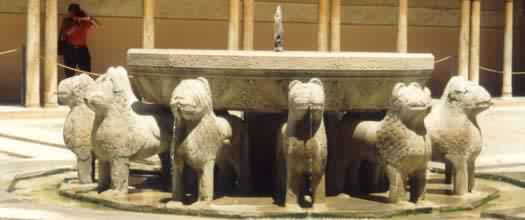
Fountain at Patio de los Leones, Moors, 8th Century
Granada, Spain
photo credit: Alexander Home Page

"In a note in the Catechism of the Council of Trent, pastors are urged to "compare the Eucharist to a fountain and the other sacraments to rivulets. For the Holy Eucharist is truly and necessarily to be called the fountain of all graces, containing, as it does, after an admirable manner, the fountain itself of celestial gifts and graces, and the Author of all the Sacraments, Christ Our Lord, from whom, as from its source, is derived whatever of goodness and perfection the other sacraments possess." (Divine Mercy Message Booklet, pg 37).

In Arab design, the highlight of a garden is always its fountain. For a desert culture, water was a source of wealth and pleasure. This ancient fountain consists of a center pool surrounding by twelve lions. Water enters the center well and exits through an ring in each lion's mouth.

To apply the image suggested by the Council of Trent, image a similar fountain with six lions instead of twelve. Instead of the Eucharist existing as merely one of seven sacraments, it should be considered the "highest" sacrament or the center well-spring of grace. Each of the other sacraments, baptism, holy orders, marriage, etc, are like the lion which help center and pour out the Eucharist into our lives.

Prayer: Merciful Savior transform our lives to more closely match our holy vocation in life and help us smoothly pour our the grace of our love and mercy into the world. Saint Faustina pray for us.

Why Make Art?

alec vanderboom


Emily: “Good-by, world, Good-by, Grover's Corners,
. . . Mama and Papa . . .
Good-by to clocks ticking . . .
and Mama's sunflowers.
And food and coffee.
And new ironed dresses and hot baths . . .
and sleeping and waking up.
Oh, earth, you're too wonderful for anybody to realize you.
Do any human beings ever realize life while they live it?-every, every minute?"

Stage Manager:"No, The saints and poets, maybe-they do some."

From Act III, "Our Town", by Thornton Wilder, American play write (p. 108)

This self-enforced Lenten Art+ Prayer series has encouraged a re-examination of what secular art means to me. As a non-Catholic, art existed outside of myself, a thrilling way for a novice girl to grasp “truth.” I gobbled down books, and plays, and movies, and pretty pictures as a means to discover myself. I felt myself becoming wiser with each new discovery. Finding a new favorite author or painter meant finding a new friend and becoming initiated into a world of ideas, witty repartee, and high sophistication. I collected favorite artists the way other women collected obscure shoes. Loving art, or wearing hip shoes, was a way to flaunt my uniqueness at future cocktail parties.

Now as a novice Catholic, I’m younger in mental years than I ever remember being. My world-view is fresh and tentative. Yet, I know an inexhaustible treasure of truth lies in the mysteries of the Catholic Church and it’s sacraments. Truth is something I try to immerse myself in each time I touch God.

Art is no longer a drug to be consumed, but something tentatively to create. My admiration of other people’s creations is no longer something to be graphed as “good” or “bad” but as something subjective that either “speaks directly to my heart” or “speaks to someone’s else heart and not mine.” Art cannot be the “Truth.” Art reflects the artist’s interaction with “Truth.” This more human, more humble, approach to art has left me profoundly grateful.

There is a strong tendency in the human condition to “fall asleep.” To take each moment in it’s entirety, in its monotone sameness, as “the end of the story.” Art, good art, for me is a wake-up call to the soul. It reminds us the life is fleeting. That circumstances change.

In Caravaggio’s Conversion, we see Saul in a humble, pitiful fall. Yet looking at this moment of confusion, I’m reminded what happens next. This tremendous moment is the start of a life infused with saintly grace. The beauty of Mary Cassatt, in her tender “Breakfast at Bed” almost causes me physical pain. I know that little ones stay little for such a brief time. I’m reminded of how often I’m the mother who worries about the toddler upsetting the coffee cup rather than taking a moment to squeeze the pudgy hips of a newly formed soul.

I’m still sorting out my screening process in art. I’m no longer yearning to attend the hippest art exhibits listed in the New Yorker. (I’m learning slowly that there are some images that are down right harmful to my spiritual development.) At the same time, I’m reassured that there is a reason I’m not as cloistered as my beloved Sister Wendy, who I just learned once snapped off “It’s A Wonderful Life” in mid-broadcast after a stressed Jimmy Stewart yelled his kids because “that is such a bad example.” I personally, needed to see the redemptive grace stated in that movie.

Art and prayer are tied together for me. I can pray after a Today Show expert on the chilling tale of African violence. Or I can watch a foreign film and feel as if my heart was loaned to another for two and half hours. Once I get it back it is forever changed. (Iraq to me is the blind boy who read the word “ALLAH” in Braille on the heads of grain, or the brother and sister who shared a single pair of shoes).

Thank you for your patience, as I spent yet another Lent reforming my thoughts on things I thought I already knew.

Prayer for Civil Authority

alec vanderboom


Tony Cragg, British artist, born 1949
"Subcommittee," Hirshhorn Scuplture Garden, Washington D.C.
photo credit: bluffton, edu

I love this sculpture, which seems to symbolize D.C. so perfectly. It consists of dozens of giant file stamps, all worn from leaving a mark on thousands of pieces of paper. The stamps are each unique yet also function as a group. They have worn groves from hanging in the same spot year after year. Staring at the sculpture on a blustery winter day, I can easily imagine a tired bureaucratic stamping “approved” or “denied” millions of times over the course of a year. The sculpture stands for both the massive weight and trivial “ordinariness” of democratic institutions.

Prayer: Holy Spirit, enlighten the leaders of all civil authority. Help the rule of law on earth more closely match God’s will in heaven.

Flying with Chagall

alec vanderboom


Marc Chagall, Russian Surrealist, 1917

On February 14, 2000, Jon got his first real kiss from me and decided that he was "in like flint." Here we are eight years later, still flying as high as a Marc Chagall painting.

Prayer: Our Blessed Mother, bless the bonds of matrimony. Keep our hearts faithful and pure.