Contact Us

Use the form on the right to contact us.

You can edit the text in this area, and change where the contact form on the right submits to, by entering edit mode using the modes on the bottom right. 


Martinsburg
United States

benjaminspring2015 (4 of 15).jpg

Alcove

Good Friday

alec vanderboom

Many thanks for everyone who took this Lenten Art + Prayer walk with me. (I think special praise goes to Joshie who read 40 posts without finding much art he liked & Et Tu Jen, who may have uncovered a new appreciation for religious art)

May all of you dear friends have a blessed and holy walk with our Lord these next few days.

(I'm taking a blogging break until after Easter Vigil. May everyone have a blessed Easter Day)

Maundy Thursday

alec vanderboom

Taking of Christ, Caravaggio

(This is my favorite Caravaggio. I love the tension in Christ's hands and the look of physical pain on his face as he meekly receives Judas' kiss.The cloak frames the three faces of St. Peter, Jesus & Judas. Caravaggio chooses to paint the soliders in contemporary uniforms, while the disciples remain in more "traditional" garments.)

Prayer: Lord, Help us closely follow your steps during this way of the Cross.

PS: Fun background story on this painting currently located in the Irish National Gallery in Dublin. This Caravaggio painting was missing for over 200 years. Two graduate students found a crumbling entrybook which listed "Taking of Christ" as one of the paintings in Caravaggio's estate. The world-wide hunt for this "lost" painting was on. It turned up in the "eating room" of a Jesuit house. It had been hanging there for over sixty years. A widow had donated the painting as a way to say thanks to her priests for doing such wonderful services for her husband. Everyone in the Jesuit order assumed the painting was just a copy. On day an art historian was appraising various paintings which the Jesuit owned. He insisted that this painting be taken down from the wall and cleansed of dirt and grime. Underneath the grime were the original brushstrokes of Caravaggio. Now this beloved painting is hanging up in a museum. (I joked with Jon that instead of hanging on a gallery wall, maybe this painting served its best purpose by inspiring the priest's as they ate their meals!)

It's Holy Week, Stay Awake

alec vanderboom


Quote on the sculpture: "Most people don't know there are angels whose only job is to make sure you don't get too comfortable & fall asleep & miss your life."


Wall Sculpture, "StoryPeople"
Brian Andreas,
approx. 8"w x 34"h, found wood & wire
(I found this artist in college. He's a poet/artist & makes wonderful sculptures, prints & fine art books).

A Christian Passover Celebration

alec vanderboom

Back when Easter & Christmas meant long visits our parents, "Passover" was the first religious holiday that was uniquely our own. I brought the tradition of a Christian seder to Jon when we got married. We've had elaborate celebrations, like our first in 2002, when the toast "Next Year in Jeresulam" meant Jon would finish grad school in a few weeks and we'd finally be "free" to live in the same house instead of nine hours apart. We've had small celebrations, such as in 2003, when we hurriedly read the Haggidad over a cup of wine holding our first newborn in our arms.

Usually we celebrate Passover on Maundy Thursday. By participating so directly in the "last supper" the Catholic Church service later in the evening seems to glow with special relevance to the Eucharist. This year, choir practice moved our Passover celebration to Monday night. Here are some snapshots of our feast.

Jon & Alex outside our door with the "lamb's blood" (in our case, some uncooked lamb)

Alex places the blood on the lamb on door post & lintel so the angle of death will "passover" our house.


Our Passover Table. We eat on the floor, wearing our sandles, and carrying our staffs. (The waterproof baby blanket is required after Daddy spilled mustard on our white carpet last year!) We pour four glasses of wine, recite blessings, and trace the traditions of the 10 plauges of Egypt. (The horses are substitute for cows getting cattle diseases, the sunglasses are for the "darkness of the sky")

Washing the Baby's feet in Memory of Christ & St. Peter
(How many kiddie tatoos did Hannah fit on her arm?)

Hannah & Alex Wash the Baby's Feet
Yummy Matza!

There are a number of great passover sites on the internet (both Jewish and Christian). You can celebrate Passover on Thursday or on the acutal Jewish holiday (April 20 -21). We hope you try out some Matza bread this Easter!

Triumph of the Eucharist

alec vanderboom


Sir Peter Paul Rubens
The Meeting of Abraham and Melchizedek, c. 1626

I finally found an online photo of that incredible 16 foot high series of paintings that I saw in Sarasota, Florida two weeks ago. Here's a write up from when the painting went on tour to the National Gallery.

"Rubens served as court painter and diplomat to the governors of Flanders, Albert and Isabella of Spain. After her husband's death in 1621, Isabella commissioned Rubens to design twenty tapestries for the Convent of the Poor Clares in Madrid. The subject of the tapestry series, woven in Brussels and still in the Spanish convent, was The Triumph of the Eucharist. This Christian sacrament reenacts Jesus' transformation of bread and wine into his body and blood at the Last Supper.

This painting is a modello, or oil sketch, for one of the tapestries. The event illustrated, from Genesis 14:1-20, is the meeting of Abraham, returning victorious from war, and Melchizedek, high priest and king of Jerusalem. Crowned with a laurel wreath, Melchizedek offers the armor-clad Abraham bread and wine, prefiguring Christ's Eucharist.

For this tapestry design, Rubens used the ingenious device of presenting the narrative as though it appears on a tapestry itself. Three flying cherubs carry the heavy, fringed fabric before an imposing architectural setting. On the right, two servants climb out of a wine cellar. Are they real men standing in front of the tapestry, or are they images woven inside it? Such confounding illusions delighted baroque connoisseurs." (NGA Website

Holy Week

alec vanderboom

Have a Blessed Holy Week everyone! Here's a song my choir sang today:

My God, My God, Why Have You Abandoned Me?
Jeremy Young

All who see me laugh at me,
they make fun of me,
they shake their heads and say:
"He relied on God?
Let his God save him!
Let God rescue him,
if God loves him!"

My God, My God
Why have you abandoned me?

I look around,
I see dogs,
I see shadowy figures
coming close to me!
They pierce my hands,
and my feet.
I can count all my bones!

My God, My God
Why have you abandoned me?

I see them taking all my clothes,
they even throw dice for them!
But you, oh God,
I feel you near!
Please God, come quickly!
Please God, help me.

My God, My God
Why have you abandoned me?

I will shout you name to my brothers and sisters!
In front of everyone I will sing your praises!
All you who stand in awe of God,
all you who love God,
all you who are descendants in faith,
give glory to God!

A Second Look at Papa Abraham

alec vanderboom


Rembrandt van Rijn
Abraham's Sacrifice, 1655
etching and drypoint, National Gallery of Art, Washington, D.C.

"Here Rembrandt portrays the moment in the story when Abraham has raised the knife to sacrifice Isaac. An angel suddenly appears, calling, "Abraham! Abraham! Do not lay your hand on the boy or do anything to him; for now I know that you fear God. In Rembrandt's work, the angel does not call to Abraham but swoops down in a stream of light and embraces him, seizing his arms to prevent him from killing his son. Many interpretations emphasize Isaac's terror. But Rembrandt focuses on Abraham, whose hand covers Isaac's eyes protectively, a tender gesture toward the son he has prepared to sacrifice. Abraham's eyes, pools of black, suggest blindness—his unwavering, blind faith in God." (NGA website)

I learned a new fact today. Muslims celebrate a religious holiday called Eid ul Adhaa, in which a sheep or goat is sacrificed and its meat shared with the poor, each year in rememberance of the "Prophet Abraham's willingness to sacrifice his son Ishmael at God's command" (Wikipedia).

Did you notice the change? Muslims belive that Ishmael (their direct descendant through Abraham's relationship with Sarah's slave Hagar) was the one to be sacrificed, instead of Isaac. Curiously, my preliminary online research showed that the text of the Torah, our Holy Scriptures and the Qur'an are fairly similar. The Torah and our Bible versus clearly say that Abraham was called to sacrifice "his only son, Isaac." I'm no expert on the Qur'an, yet the text appears to be silient on the actual name of the son to be sacrificed. The Qur'an states that Abraham was asked by God to sacrifice "his only son". Catholics (and Jews) believe that Isaac was the promised son, the one through whom Abraham was promised descendants "as countless as the stars." The text that I read from the Qur'an doesn't seem on its face to contradict this passage of Genisis. Yet some (not even all) Muslim experts insert Ishmael's name into the text since "only son" must mean that the events occured to Ishmael before Isaac was born.

This inter-family fight between all our brothers in the faith (Jews and Muslims) highlight the importance of this central event in establishing the initial priviledged relationship with God.

I realize how little I know about Islam. I want to read the Qur'an myself. I'll get more out of it if I have a good supportive text. Does anyone know a Catholic scholar who writes about passages in the Qur'an?

Prayer: Lord, as we prepare to celebrate your Passion, help us unite our prayers with our brothers in the faith, the descendants of Abraham. May all Jews, Muslims and Christians be one day united in singing praises to our one Creator in heaven.

Staying On Point/ Pointalism

alec vanderboom

I fell in love with the sport of fencing during my senior year in college. I love everything about fencing. I love the fancy footwork. I love the dramatic leaps, the delicate finger movements under my foil. I love pacing the narrow ten foot strip and the dash of a deflected repost. I even paced my dorm hallway at night with endless deep knee bends just to increase my stamina.

There was one part of fencing class that I hated; "point practice." One of the major keys of being a great fencer is to have 100% consistency in your fingers' fine motor skills. When you go for the dramatic leap to get a point, you need to be sure that your sword (the foil) will land exactly where you aim. To strengthen our aim, my fencing coach had us stand five feet from a 1/2 inch mark on our gym wall. Over and over again, we had to extend our arms and perfectly hit the mark.

I hated this practice. I'd hit the mark four or five times and then start getting bored. My mind would wander. The point of my sword would wander. I'd miss the mark. My foil point would go to far up or to far down. I try to refocus and my fingers would refuse to cooperate. My work on this exercise was beyond awful. "How long do we have to keep doing this?" I wonder outloud again and again.

This morning I thought about "point practice" and how it is the perfect metaphor for my struggles with stay-at-home motherhood. We had a great week. Lots of good home-school experiences, better discipline practice, fully cooked meals, clean laundry, etc. In general a lot more love and more cheerfulness in our home. Then came this morning. Baby girl is cutting her second incisor and is back to her "nursing all night long" routine. Instead of getting out of bed early to share a cheerful breakfast with my husband, I stayed in bed until 9:30. That left my awake older kids unattended for an hour, with only the barest, most incoherant mothering happening from my bedside.

When I finally got up, I found a raw egg on the living room carpet (how did a raw egg mixed into the batch of hard boiled Easter Eggs?) and purple marker smeared over my wooden dining room table. Luckily, I managed not to lose my temper since I distinctly remembered "can we play school?' and "can I eat an Easter egg" being part of the 'mom's in bed" morning conversation. So, I cleaned up the mess. I put the older kids back in their room to play and made myself a much needed cup of coffee.

This is "point practice" all over again, I realized. I've got so many talents for mothering. The major thing I lack is the virtue of temperance. Consistency is so against my natural inclinations. As a mother, I need to hit the mark day after day. It's not enought that somedays we make cookies, walk the stations of the cross, and indentify four types of pine trees. There are many things; meals, laundry, a steady morning routine, which have to be "hit" each day no matter what.

Steadiness, is a grace I'm eager to embrace this Easter Season.

For artistic inspiration, I chose "pointalism". In this form of impressionist painting, each paintstroke is a tiny, specific dot of color. From a distance, the dots blend together to create an illusion of form. The technique takes "forever!" Standing in front of the giant canvas of Sunday in the Park, you admire the stamina that Seurat had, even more than his brillant choice of subject matter or revolutionary color theory.


(click on picture to enlarge it)

Text from "Sister Wendy's American Masterpieces":
"Seurat's Grande Jatte is one of those rare works of art that stand alone; its transcendence is instinctively recognized by everyone. What makes this transcendence so mysterious is that the theme of the work is not some profound emotion or momentous event, but the most banal of workaday scenes: Parisians enjoying an afternoon in a local park. Yet we never seem to fathom its elusive power. Stranger still, when he painted it, Seurat was a mere 25 (with only seven more years to live), a young man with a scientific theory to prove; this is hardly the recipe for success. His theory was optical: the conviction that painting in dots, known as pointillism or divisionism, would produce a brighter color than painting in strokes.

"Seurat spent two years painting this picture, concentrating painstakingly on the landscape of the park before focusing on the people; always their shapes, never their personalities. Individuals did not interest him, only their formal elegance. There is no untidiness in Seurat; all is beautifully balanced. The park was quite a noisy place: a man blows his bugle, children run around, there are dogs. Yet the impression we receive is of silence, of control, of nothing disordered. I think it is this that makes La Grande Jatte so moving to us who live in such a disordered world: Seurat's control. There is an intellectual clarity here that sets him free to paint this small park with an astonishing poetry. Even if the people in the park are pairs or groups, they still seem alone in their concision of form - alone but not lonely. No figure encroaches on another's space: all coexist in peace.

"This is a world both real and unreal - a sacred world. We are often harried by life's pressures and its speed, and many of us think at times: Stop the world, I want to get off! In this painting, Seurat has "stopped the world," and it reveals itself as beautiful, sunlit, and silent - it is Seurat's world, from which we would never want to get off."

(This painting has also been turned into a play called "Sunday in the Park" which is currently performing on Broadway).

Prayer: Lord, give us the strength and temperance to consistently hit the mark on our daily tasks.

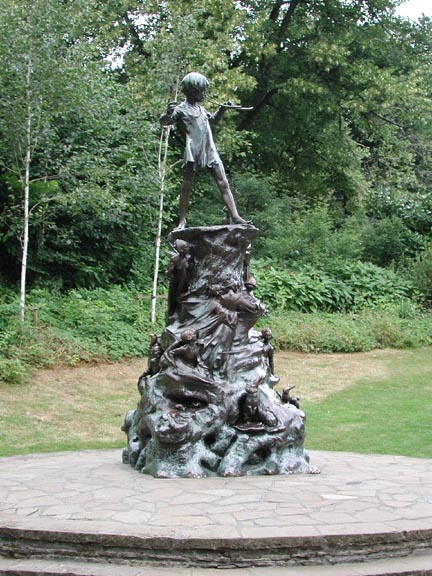
Peter Pan

alec vanderboom


Peter Pan
Sir George Frampton, R.A., P.R.B.S. (1860-1928)
Bronze
Kensington Gardens, London
Photograph 1999 copyright George P. Landow, http://www.victorianweb.org/sculpture/frampton/pp1.html

Today I wrote out the bills for the paycheck Jon gets tomorrow. After our trip to Florida, my traffic ticket, our high heating bills and the frantic bribery which is accompanying Alex's toilet training, our squeaky tight budget is far off track. No time to recoup our losses in the near future. The next two weeks will bring us Easter, a trip to my parents house, and Hannah's birthday. At times like these you can only trust Providence and fling yourself on the delightful words of J. M. Barrie's "Peter Pan."

"For a week or two after Wendy [was born] it was doubtful whether they would be able to keep her, as she was another mouth to feed. Mr. Darling was frightfully proud of her, but he was very honourable, and he sat on the edge of Mrs. Darling's bed, holding her hand and calculating expenses, while she looked at him imploringly. She wanted to risk it, come what might, but that was not his way; his way was with a pencil and a piece of paper, and if she confused him with suggestions he had to begin at the beginning again.

'Now don't interrupt,' he would beg of her. "I have one pound seventeen here, and two and six at the office; I can cut off my coffee at the office, say ten shillings, making two nine and six, with your eighteen and three makes three nine seven, with five naught naught in my cheque-book, makes nine seven, dot and carry seven-don't speak, my own- and the pound you lent to that man who came to the door- quiet, child- dot and carry- child, there, you've done it!- did I say nine nine seven? yes, I said nine, nine seven; the question is, can we try it for a year on nine, nine seven?

'Of course we can, George,' she cried. But she was prejudiced in Wendy's favor, and he was really the grander character of the two.

'Remember mumps,' he warned her almost threateningly and off he went again. 'Mumps one pound, that is what I have put down, but I dare say it will be more like thirty shillings- don't speak-measles one five, German measles half a guinea, makes two fifteen six- don't waggle your finger- whooping-cough, say fifteen shillings'- and so on it went, and it added up differently each time; but at last Wendy just got through, with mumps reduced to twelve six, and the two kinds of measles treated as one.

There was the same excitement over John, and Michael had even a narrower squeak; but both were kept, and soon you might have seen the three of them going in a row to Miss Fulson's Kindergarten school." (pg 9-10).

(If you have not read J.M. Barrie's original Peter Pan, or seen Jonny Depp play Barrie in the movie "Finding Neverland", I highly recommend both)

Prayer: Lord, we need your guidance to make prudent financial decisions for our families. Help all Americans, however, avoid Mr. Darling's antics. May we never count the "high" cost of childrearing as a reason to exclude new babies from our families.

alec vanderboom


A Veteran In A New Field, Winslow Homer 1865
Boston Fine Art Museum

This is a famous American painting of a Confederate solider "demobalized" after the end of the Civil War. On the lower left hand corner there is a grey army jacket and an army canteen. Homer choose an ordinary moment in time which is also highly symbolic. Cutting wheat was an important part of American ante-bellum agriculture. Yet it also harkens to the glory of the Roman solider who easily puts down his weapon in a time of peace and returns to his farm work. There is also a Biblical passage which states "and their weapons shall be beaten into plowshares." The tension of the scythe cutting full heads of wheat, also suggests the many young men who were killed in battle.


Crack the Whip, Winslow Homer 1800s
American Art Museum, Washington D.C.

This iconic painting is one of Homer's most famous, showing boys at play beside a one-room school house on the frontier. The boys are humble (no one has no shoes) yet happy. Despite their current poverty, the boys have the promise of a free education and a free land from the US Homestead Act.

Prayer: Lord, while we are at work and at play, let us humbly remember the fighting men and women who are far from their families this Lenten Season. May we all pray for peace this Easter.

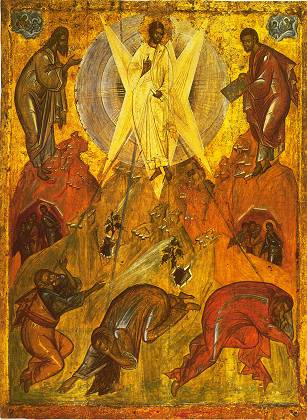
Greek Icon

alec vanderboom


The Transfiguration
Theophanes the Greek, 1403

Iconography is different than "regular" painting. It is intended to be a window onto divine understanding. This icon from 1403 shows the strong Byzantine tradition (all those symmetrical folds of the garments) combined with a new knowledge of proper anatomy (the position of the kneeling disciples). Theophanes the Greek is one of the most famous icon makers in history.

Prayer: Lord, please help us understand the dual nature of your humanity and your divinity as we prepare to walk in your footsteps this coming Holy Week.

Pro-Life Art

alec vanderboom

For the last year, I've noticed "pro-life" messages coming from the oddest places. Even before Juno, there were 20 something movies like "Knocked up" and "The Waitress." Life started being protected by even most jadded of the artistic set. These movie scenes give me so much hope. Artists are the avante garde of society, if they are starting to promote the value of life since conception, how can a reversal of public opinion be far behind?

During the writer strike, my husband and I discovered reruns on nbc.com of Friday Night Lights, the television series of a high school football team set in Dillion, Texas. Even if you're a newbie to this fantastic series, please check out the best "pro-life" speech I've ever seen on TV.

To set the stage, Jason is a former star quarterback who became paralysed after a bad football tackle. Dealing with the emotions of his injury, he falls into unchastity with a one-night stand. When the girl tells him she's pregnant, he realizes that this is his one chance to become a father. (His spinal injury makes fertility a near impossibility.) The writers use this "injury" to explain why Jason desperately wants this baby. While very few 18 year old's worry about their fertility, Jason's situation is typical of the helpless the situation of fathers today. The decision to have an abortion rests entirely with the child's mother. Jason's plea for the mother of his child to choose life is one of the most touching things I've seen on television.
Kudos to the writers of Friday Night Lights!

I'll try to figure out how to better post a link to this series. In the meantime, use this link:

http://www.nbc.com/Friday_Night_Lights/video/episodes.shtml#vid=215724

Episode 215, go to min. 40
the conversation is from mins. 40-43

Sister Wendy Beckett

alec vanderboom


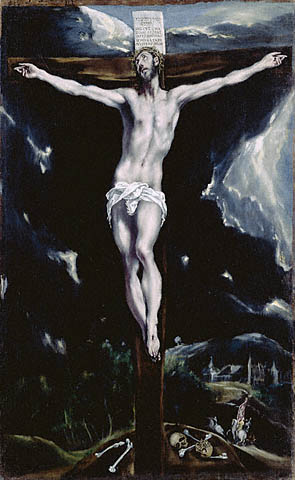
El Greco, Christ on the Cross,
One of Sister Wendy's favorite paintings

"Prayer In Everyday Life"

"Everybody reading this book has his or her own vocation and his or her own life.

Perhaps you have a baby? Perhaps you have an especially demanding workload? Perhaps you are lonely? Perhaps you are angry? None of this matters. It is who you are that God comes to in prayer, and if it is a tired, fractious, despondent man or woman, He still takes you to Himself with infinite love and makes the best of what you can give Him. Your life is not my life. I long to use what has happened and is happening to me as a place where God can reveal His love. My regime, my life, may sound more romantic, more spiritual thant yours, but yours is equally valid, equally a place for God to reveal Himself. Crying baby, difficult boss, the pressures of the mortgage, all of the horrors of the workplace- none of these are invalidating; they just make part of the reality that is you, and it is only to this reality that God can respond.

What matters is that whatever your circumstances, however helpful (like mine) or unhelpful (I hope not like yours) we retain possession of our selfhood and offer it to God. It is the offering that matters, the will, the choosing. If you life is difficult, it could well be that you are more open to God than someone like myself whose life has been so sheltered.

Sometimes people have told me, "I felt too sick to pray." If you think about it, this is really saying, "God cannot come to the sick." What is meant is, "I feel too sick to feel I am pryaing," or "I feel too worried to feel I am praying. How can I pray when all I can think about is my coming operation?" This misunderstands the essence of prayer, which is God's business. You bring yourself ni whatever state you are and offer that to God. There may be very little satisfaction in this. All you may be conscious of are your own feelings, miserable and inadequate, but God does not ask us to pass a test of how beautiful our feelings are. He simply wants us to pray." (Sister Wendy on Prayer, pg 42-43).

Prayer: Christ, come to us as we are. Find us broken and alone. Heal us in time for your Easter Day.

A Catholic Art Critic

alec vanderboom

"Becoming Catholic" has been a gradual process for me. I have some definative moments, to be sure. But mostly the changes have been slow and steady. I've slipped from the shallow pool of Protestantism into the deep end of the Catholic faith. However, I usually don't notice the dramatic change until I look around from my frantic treading water, notice how far the pool floor is beneath me and think "Wow, never thought I'd be in this deep before."

Going to the swimming pool and going to the beach in Florida was a great time to measure how far my little family has grown up this year. Going to an art museum with my husband for the first time in almost five years without a kid (thank you cousin Suzanne!) was a mark on how far we have both grown as Catholics.

The Ringling Museum in Sarasota, Florida is a collection of European "great names" bought with money from circus tickets. The museum sits in a recreated Italian villia with two wings on each side. The first thing you notice when you enter the museum are 15 foot high paintings done by Peter Paul Ruben. I spent my time mostly in the Counter-Reformation and medival art gallery. For the first time, I skipped over most of the greek revival and baroque art. (Those are just myths I thought, I need to drink in some truth).

I've never been much of a Ruben's girl before. The pudgy angels and flowly fabrics before seemed "a little much." This time I wasn't solely looking through the eyes of art, as if I were picking out a fun sofa fabric. This time I looked through the eyes of Faith.

Ruben's entire collection was a defense of the basic article of our Catholic faith, transubstantiation. This is a mystery which I've been trying dive deeper into this Lent. Sitting in the middle of these huge, huge paintings, I carried on an intimate conversation with the famous painter. He showed me paintings of the early "echos" of transubstantiation, manna from heaven, the food sacrifices from the old prophets. He showed me "defenders of the Eucharist", Saint Clare of Assisi holding a giant monstronce while Thomas Aquinus scribbles behind her with the quill pen. "Doesn't Saint Clare look like an old friend?" I mused.

Sitting with Ruben, I felt calmed and protected. This debate against Protestant hearsay has been going on for over 500 hundred years. The force of the Counter-Reformation is still going on. Yet, Ruben knew the truth. He spent years painting his giant paintings to make sure that the world recognized the beauty of the Eucharist as well. Not initially liking the pearly "flesh" tones on his human figures seems like such a petty reason to dismiss an artist out of hand. We have so much basic theology in common. I look foward into drinking in Ruben, El Greco and Carvaggio this Easter season.

Dali

alec vanderboom


Who knew that the creator of the Lobster Telephone (1936) also struggled to come to terms with his Catholic faith? We checked it all out and more at the St. Petersburg's Salvador Dali Museum.

St. John of the Cross (Dali's painting is based on a 16th century sketch by this beloved saint).

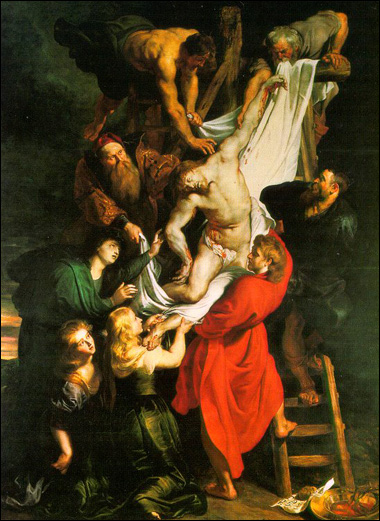
Ruben

alec vanderboom


Peter Paul Ruben, The Deposition

Unfortunately, I haven't found images on the web of the amazing 10 foot high Ruben paintings on "defense of the Eucharist" that we saw at the Ringling Museum. It turns out that Ruben was born a Protestant, but later converted with his mother to Catholicism. He was an important painter of the Counter-Reformation. Most of his religious work "defends the truth of the faith" against Protestant attack.

From what I remember of Art 100, this is an unusal painting which shows the "heaviness" of Christ's dead body. Painters usuasally show Christ as rail thin and frail. (Check out your own church crucifix next week). Showing Christ as "barely human" is supposed to communicate his divine nature. Ruben takes the opposite approach. We get a sense of Christ's fully developed muscles, of the complete weight of his dead body which takes several mourners to unload from the cross. This loss of a fully human Jesus communicates the despair and loss of Good Friday.

The Sorrowful Mysteries

alec vanderboom


Blue Madonna (The Sorrowful Mysteries), Carlo Dolci, 1660
Ringling Museum, Sarasota, Florida

Jon & I prayed by this arresting image of our Blessed Mother. The cobalt blue in this painting "glows" in person. We loved seeing the sliver of her face. The eyes show the weight of her sorrow, but she's not "depressed". Her head is slightly tilted in resignation and perfect humility. I feel like this is the face that we'll see more clearly in heaven. It was like having an intimate conversation with a painter who died over 300 hundred years before we were born.

Prayer: Blessed Mother, pray for us. Help us to bear our crosses with wisdom and humility.

Beach Day

alec vanderboom


I'm signing in from a remote (read a heavenly location- St. Petersburg, Florida) and I am running into some technical difficulty importing pictures to my website. Please use this link for a sweet look at how I spent my day).

Mary Cassatt
Children Playing on the Beach
1884
National Gallery

"Children Playing on a Beach demonstrates Mary Cassatt's skill at capturing the natural attitudes of children. The intent expression on one child's face, the lowered angles of their heads, and the set of their shoulders suggest complete concentration on their activities. Especially appealing is the awkward way in which the toddler on the left grips the long handle of her shovel while holding the rim of the bucket with her other pudgy hand.

Cassatt's interest in structure and strong sense of patterning comes through clearly in this painting. Her careful brushstrokes follow the contours of the girls' arms, legs, and heads, creating the solid areas of color typical of her work after 1883. To keep the center of attention on the little girls, Cassatt treated the seascape background more loosely; the boats on the ocean melt into a haze of natural light. She emphasized surface pattern by repeating the accents of dark dresses under crisp white pinafores." (NGA website)

Prayer:Ave Maris Stella
Hail, O Star of the ocean,
God's own Mother blest,
ever sinless Virgin,
gate of heav'nly rest.

Taking that sweet Ave,
which from Gabriel came,
peace confirm within us,
changing Eve's name.

Break the sinners' fetters,
make our blindness day,
Chase all evils from us,
for all blessings pray.

Show thyself a Mother,
may the Word divine
born for us thine Infant
hear our prayers through thine.

Virgin all excelling,
mildest of the mild,
free from guilt preserve us
meek and undefiled.

Keep our life all spotless,
make our way secure
till we find in Jesus,
joy for evermore.

Praise to God the Father,
honor to the Son,
in the Holy Spirit,
be the glory one. Amen.

More Gorgous Dutch Shots

alec vanderboom


Pieter de Hooch
A Dutch Courtyard, 1658/1660
Andrew W. Mellon Collection
National Gallery

I'm not sure what our internet connection will be over the next few days. Here's another gorgous Dutch pictures to get you through. I'll write more about how important the 1650s were for Dutch artists, soon! Hope to introduce you all to some more new favorite painters.

Prayer: Blessed Mother, help us extend hospitality to those we meet, especially whenever we feel too tired or too cross.